
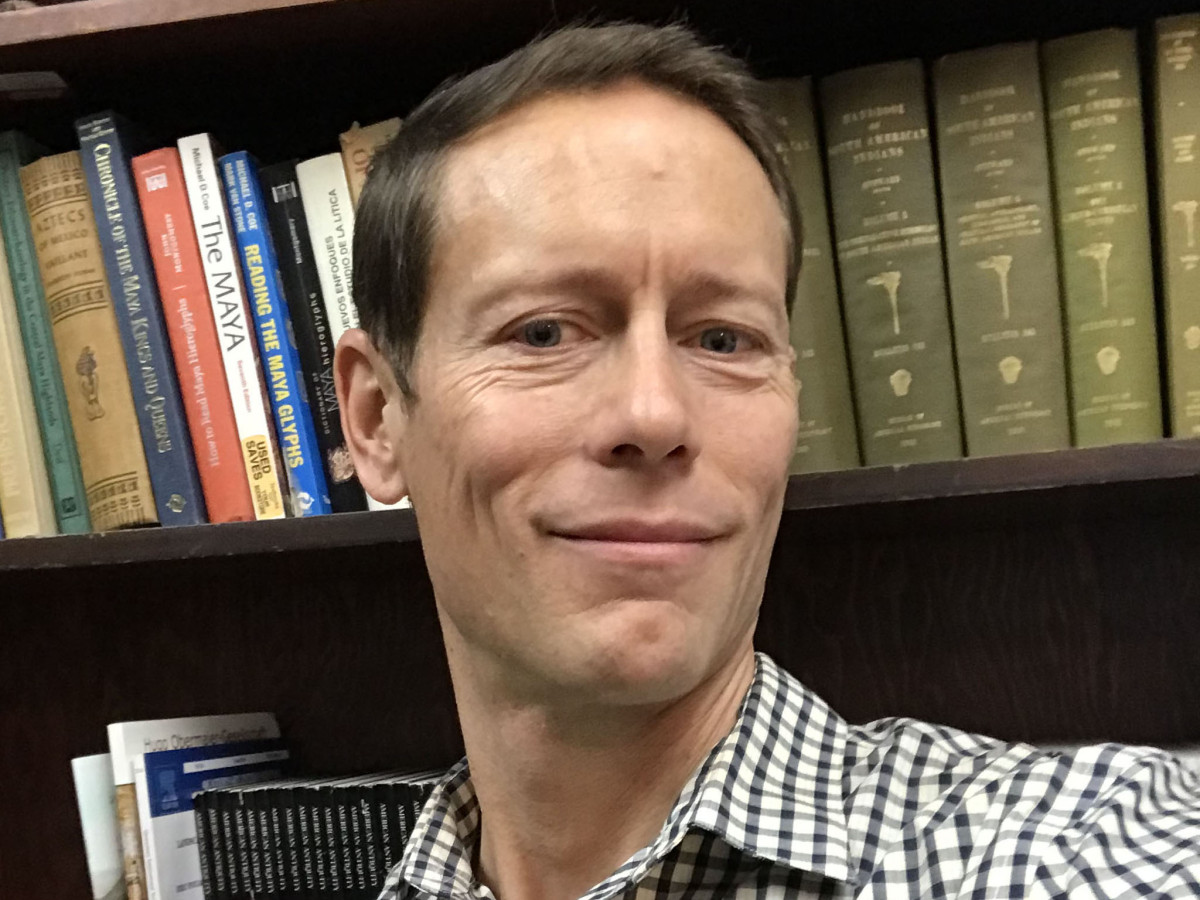
Matthew Pailes received his B.A. in anthropology from the University of Oklahoma (2005), and his master’s (2008), and Ph.D. (2015) from the University of Arizona. Since 2016 he has been an Assistant or Associate Professor at the University of Oklahoma. He has worked in a variety of locations including the Southwest, Southeast, and Plains of the U.S. as well as overseas in Morocco. His principal research endeavors are in Northwest Mexico where he has focused on the political economy of the 12th to 16th century. For the past 7 years he has collaborated with colleagues John Carpenter and Guadalupe Sanchez on investigating the variable histories of different valleys throughout the Sierra Madre Occidental through a project funded by both the National Science Foundation and the Consejo Nacional de Humanidades, Ciencias y Tecnologías.
### 2013 Fellow Abstract Summary
Matthew’s dissertation focused on an area that had received relatively little research: eastern Sonora, Mexico. Titled Traders and Farmers: 10th to 16th Century Occupation of the Rio Moctezuma Valley, Sonora, Mexico, his dissertation examined the period immediately before Spanish colonization. Archaeologists had long speculated about the importance of this region during that time period: was it a conduit for Mesoamerican influence; an area settled during a diaspora of Hohokam and Mogollon emigrants; or, along with the Pueblo communities of the southwestern United States, one of the last major population and political centers to remain after the demise of Paquimé? These were important questions, but the archaeological evidence from the region had been insufficient to provide answers. Matthew’s research sought to fill this important gap in knowledge.
Despite being a critical component in any macro-scale reconstructions of ancient history in the southwestern United States and northern Mexico, eastern Sonora had received extremely sparse archaeological attention over the last 40 years. It even lacked a basic chronology. Matthew’s research provided the first chronological sequence and the first comprehensive reconstruction of social organization for the region. He accomplished this by conducting a settlement survey in the Moctezuma Valley and analyzing legacy data from neighboring valleys.
Matthew’s research provided the first estimates for the number of people living in the study area and assessed how population size changed during the late period. He also conducted artifact-sourcing studies to reconstruct local pottery-exchange networks and long-distance exchange of obsidian and shell. His analyses of regional demography and exchange networks allowed him to reconstruct the region’s social organization and evaluate existing but untested models about eastern Sonora settlement and the role it played in the ancient history of northern Mexico and the southwestern United States. His findings determined whether existing models were correct or if an entirely new model was needed to understand this important region during the period before Spanish colonization.