
Cultural Resource Management (CRM) Field School
June 21 – July 4, 2026
Cultural Resource Management (CRM) Field School
June 21 – July 4, 2026
Crow Canyon Archaeological Center Campus, Cortez, CO
Required Materials to Attach to your Application:
-
- One (1) letter of recommendation
- A list of relevant trainings and coursework, AND
- Resume or Curriculum Vitae
Important Dates:
-
- Sunday—03/15/26: Complete applications due for priority consideration
- Tuesday—03/31/2026: Applicants will be notified of selection status
- Monday—05/11/2026: Paperwork due for selected participants
- Monday—05/11/2026: Payment of $1,500.00 due to Crow Canyon for selected participants
- Sunday—06/21/2026: 2026 Cultural Resource Management Field School begins. Arrive on campus between 12:00 p.m. and 2:00 p.m.
- Saturday—07/04/2026: 2026 Cultural Resource Management Field School ends
Fee: $1500
-
- Includes instruction, equipment, housing, and meals at Crow Canyon Archaeological Center, and local transportation. (see more)
- Transportation to and from Cortez, CO and your personal gear are your responsibility.
Earn college credit during the CRM Field School!
Applicants do not need to be in college or a grad student to enroll.
Students may enroll in college course credit (3 credits) through Adams State University. For questions about college credit, contact Kelsey Hanson.
OVERVIEW
There is significant demand for a trained archaeological workforce nationwide, particularly in southwest Colorado as it contains the highest density of archaeological sites in the contiguous United States. Construction projects that disturb the ground and trigger local, state, and/or federal regulations require the services of contract archaeologists in an industry called Cultural Resource Management or CRM.
Fewer than 10% of practicing archaeologists work as university or college professors or for a museum or laboratory. Most archaeologists practicing today work under the auspices of Cultural Resource Management, whether as a consultant, or for tribal, local, state, or federal governments to review the work of private sector archaeologists.
Crow Canyon’s Cultural Resource Management (CRM) Field School is an intensive two-week course in Southwest Colorado that teaches practical cultural resource management (CRM) fieldwork skills for swifter entry into the private workforce after college. Held on private land at the Hawkins Preserve this course presents real-world opportunities to practice the principles of cultural resource management archaeology. Upon completion of the course, the students are able to:
-
- Identify and document an archaeological site, including site mapping and photography
- Understand and contribute to recommendations for National Register of Historic Places (NRHP) eligibility of sites
- Fill out appropriate site records
- Navigate infield recording technology
- Conduct pedestrian survey
- Understand the laws and legislation that drive CRM
- Conduct basic laboratory analyses
- Contribute to CRM report sections
Course Format: Lectures, lab analyses, in-field survey and site documentation, evening programs, and field trips in the Mesa Verde region.
CO-DIRECTORS
Dr. James Potter, Dr. Kelsey Hanson
Questions: Contact us at fieldschool@sandbox.crowcanyon.org

Kelsey Hanson
CRM Field School Co-Director; 2021 Lister Fellow; 2016 Field Intern
Kelsey is an anthropological archaeologist whose collaborative research and applied CRM leadership focus on sociopolitical organization, technology, and human–environment interactions across the U.S. Southwest, Great Lakes, Texas, and Mexico.


Dr. James Potter
CRM Field School Co-Director
Dr. Potter is a veteran CRM archaeologist with over 30 years of experience in the Western United States, co-director of Crow Canyon’s CRM Field School, editor of American Antiquity, and a senior advisor and board member advancing professional archaeological practice.

Matthew Steber
CRM Field School Program Instructor
Matthew is a Field Director at Chronicle Heritage, specializing in Southwest archaeology and geoarchaeological documentation, and has over nine years of experience conducting extensive CRM fieldwork.

Kegan Roady
CRM Field School Program Instructor
Kegan is an Associate Archaeologist at Chronicle Heritage with over eight years of project experience in the private, government, and academic sector across the North American Southwest, Rocky Mountains, Basin and Range, Great Plains, and Southeast.
GUEST LECTURERS
Theresa Pasqual, Fermin Lopez, Shanna Diederichs, Jason Chuipka, Christopher Goodmaster

Shanna Diederichs
Architectural Conservator and Vice President at Woods Canyon Archaeological Consultants
Shanna is a Southwestern archaeologist with 22+ years of experience—from the U.S. Southwest to Egypt—combining research, site conservation, and public education to bring past cultural landscapes to life.

Theresa A. Pasqual
Executive Vice President of Indigenous Affairs
Theresa is a member of Acoma Pueblo and works toward the protection of cultural landscapes, expansion of traditional ecological knowledge in scientific study, academic research, and policy based in equity, social justice, and inclusion.

Fermin Lopez
Research Associate-LiDAR Group
Fermin is a tribal member from the Pueblo of Pojoaque and currently sits as the Historic Preservation Officer for the Pueblo of Pojoaque Tribal Historic Preservation Office.

Jason Chuipka
Co-Owner and Vice President of Woods Canyon Archaeological Consultants
Jason has over 30 years of experience leading and managing archaeological projects in the northern Southwest, with research expertise in Ancestral Puebloan architecture and the Eastern Mesa Verde region.

Christopher Goodmaster
Principal Investigator at Integrated Environmental Solutions, LLC
Christopher is a Principal Investigator at Integrated Environmental Solutions, LLC (Denton, TX) with over 22 years of experience specializing in geophysical remote sensing, photogrammetry, and 3D mapping for cultural resource management.
ACCOMMODATIONS
Housing costs are included with this program. Accommodations are in modern, shared cabins on Crow Canyon’s campus. Students must provide their own sleeping kits (see gear list).
-
- Cabins include shower and toilet facilities.
- Crow Canyon provides Wi-Fi Internet service in campus buildings.
- Laundry facilities are available to students.
MEALS
Meal costs are included with this program.
-
- All meals included, seven days a week for breakfast, lunch, and dinner. On-campus meals are served cafeteria-style in the lodge.
- If you are working in the field, snacks, water, and a picnic lunch (sandwiches, fresh fruit, chips, and cookies) are provided.
CAMPUS
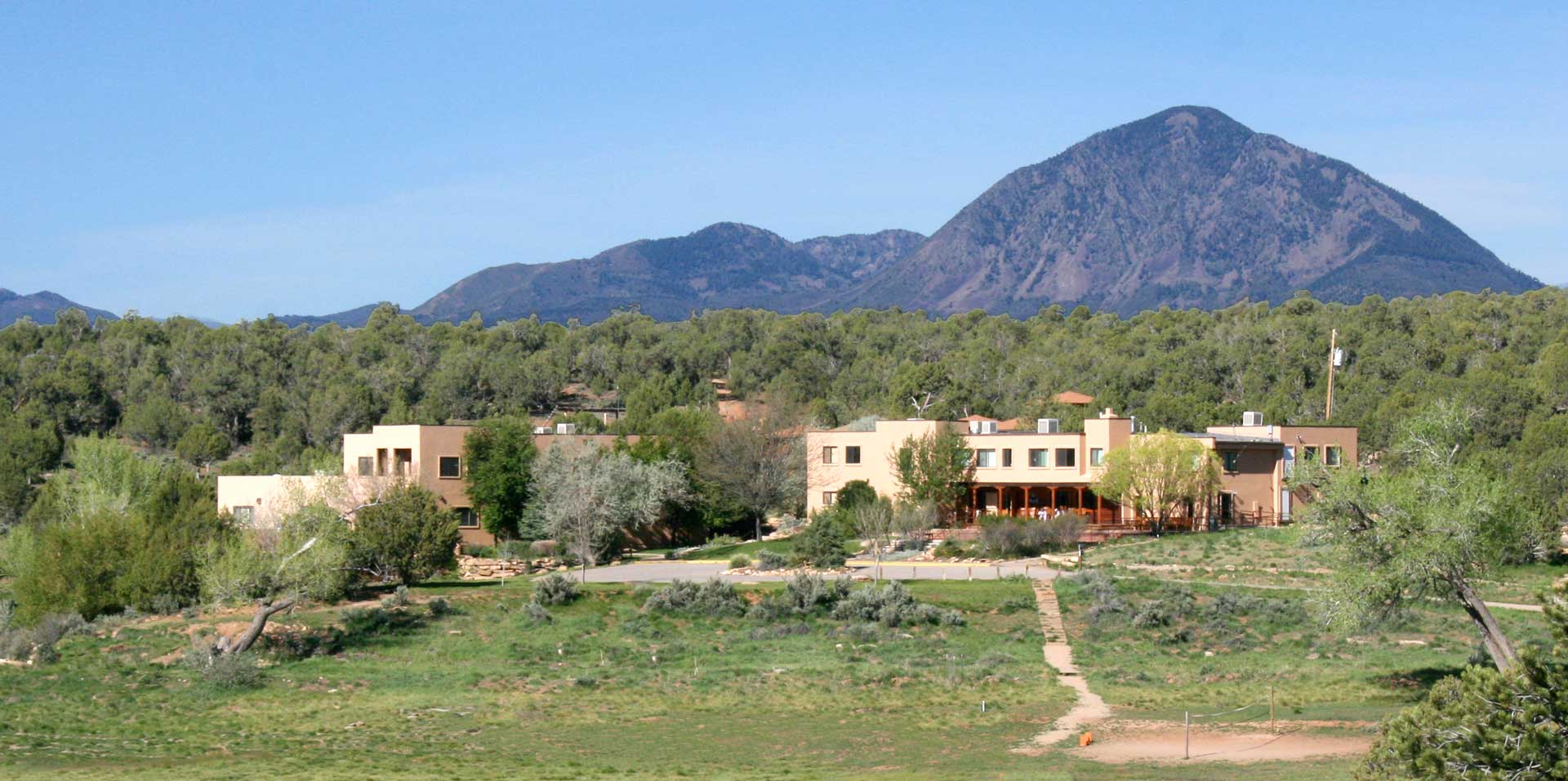
Crow Canyon’s 170-acre campus, located just outside the town of Cortez, features a large meadow, pinyon- and juniper-covered hillsides, and spectacular views of Mesa Verde and the La Plata Mountains. A short nature trail winds through the woods. Buildings on campus include the Lodge, cabins, 10 Diné-style hogans, two outdoor learning centers, and the Gates Archaeology Laboratory (the Gates Building), which houses classrooms, libraries, offices, and a material culture laboratory. A lounge area is also available in the Gates Building.
All facilities are smoke-free. Wildfires are a real danger in our area; if you smoke, please do so only in the designated smoking area, at the picnic table behind the lodge. Smoking by minors (under age 18) is prohibited. In addition to hosting human participants in Crow Canyon programs, our rural campus is also visited by a variety of wildlife, including deer, rabbits, marmots, birds, snakes, lizards, foxes, coyotes, and the occasional mountain lion.
Learn more about campus life.

Testimonials from former CRM Field School Students:
“I think the best part about field school was how much it taught me about CRM and archaeology as a whole in those two weeks. It felt like I learned a whole semester’s worth of info in two weeks. And I was able to then apply what I learned each day, which really helped to cement it. It changed my whole perspective on what it meant to be an archaeologist.” — Jack Christiano, student
“…What an amazing two weeks. The best thing about field school was going into the field and identifying artifacts, putting those items into words and then translating it on to the iPad. I feel like this skill is so important in CRM and will be something I need regardless of where I land.” —Anthony Kline, student
“The field time we had was invaluable…because we could practice and learn. If we made mistakes, we were coached through them. It made a huge difference being able to continuously practice and get better. It was extremely helpful, and it really solidified that I like doing this work.” —Will Ryan, student